
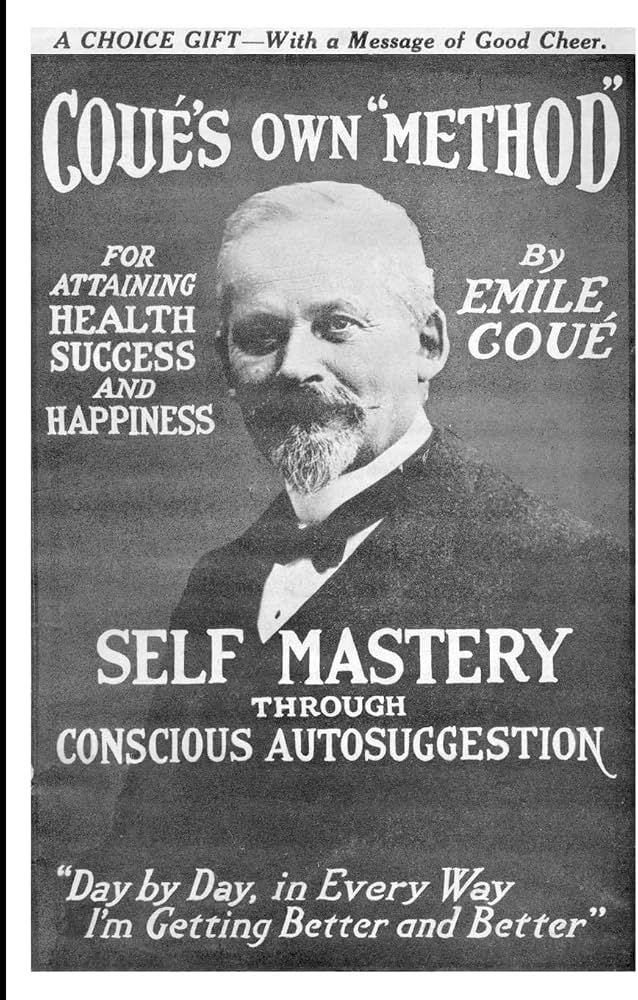
If you have taken a hypnosis course, you have almost certainly been handed a list called The Laws of Suggestion, credited to Émile Coué. It usually runs to six items: concentrated attention, reversed effort, dominant effect, auxiliary emotion, repeated effect, subconscious teleology.
It is a good list. Those principles are real and they work.
They are also not Coué’s.
This is one of those pleasant little corrections that makes you better at the thing you already do — because when you go back and read what Coué actually wrote, the four laws he did set down turn out to be more useful than the six he gets credited with.
Who he was
Émile Coué was a French pharmacist in Nancy, and he noticed something that most of us would have walked straight past. When he praised a remedy as he handed it over, it worked better. Same medicine, same patient, different words. He had found the placebo effect two decades before medicine took it seriously, and rather than shrug, he spent the rest of his life working out how to use it on purpose.
He is best remembered for a sentence: Every day, in every way, I am getting better and better. Say it twenty times each morning and evening, lightly, without straining. Half of Europe was saying it in the 1920s.
But underneath the famous line sits a small and very sturdy piece of theory.
The four laws, in his own words
In Self-Mastery Through Conscious Autosuggestion, Coué says he has “been able to deduct the following conclusions which I have summed up as laws”:
One. When the will and the imagination are antagonistic, it is always the imagination which wins, without any exception.
Two. In the conflict between the will and the imagination, the force of the imagination is in direct ratio to the square of the will.
Three. When the will and the imagination are in agreement, one does not add to the other, but one is multiplied by the other.
Four. The imagination can be directed.
That is the whole list. Four.
And Coué, to his credit, immediately adds a footnote of his own: the phrases “in direct ratio to the square of the will” and “is multiplied by” are, he says, not rigorously exact — they are illustrations, meant to make his meaning clearer. He was reaching for the language of physics in 1920 and he knew it. Laws two and three are the same idea as law one, dressed up in mathematics that does not quite hold.
Which leaves two laws doing the real work.
Where the other six came from
The longer list belongs largely to Charles Baudouin, a psychologist who worked alongside Coué at what became known as the New Nancy School. His book Suggestion and Autosuggestion was published in 1920, and it is Baudouin who gives us concentrated attention, reversed effort, dominant effect and auxiliary emotion. Later writers added to the set, and somewhere in the retelling the whole collection slid over onto Coué’s name and stayed there.
You will find it miscredited in textbooks, in certification manuals, in the first page of Google results. Nobody is being dishonest. Everyone is copying the person before them.
Baudouin deserves his name on his own work. And Coué’s four deserve to be read as he wrote them, because the first one is the single most useful sentence in our field.
The two that do the work
| Coué’s law | What it says | Why it matters |
|---|---|---|
| Imagination beats will | When will and imagination are in conflict, imagination always wins | Your client has already tried willpower and lost. Aim at the picture, not the effort |
| Imagination can be directed | The picture can be steered — by language, metaphor, rehearsal and trance | This is the whole job. Everything else is a way of doing it |
Baudouin’s laws, briefly
They are worth knowing properly, whoever wrote them:
| Law | What it says | What you do with it |
|---|---|---|
| Concentrated attention | Whatever the mind dwells on repeatedly tends to come about | One theme per session. The focused session beats the comprehensive one |
| Reversed effort | The harder you consciously try, the more surely the opposite arrives | Strike try from your suggestions. “Allow,” not “try to” |
| Dominant effect | A stronger emotion displaces a weaker one | Fasten the suggestion to what the client actually cares about |
| Auxiliary emotion | A suggestion delivered with feeling beats the same words delivered flat | Mean it. Slow down on the line that matters |
| Repeated effect | An idea returned to becomes an idea believed | Repeat the key suggestion in different clothes; give homework |
| Subconscious teleology | The subconscious works toward an end and finds its own route | Suggest the destination, not the mechanism |
Read them together and they are six answers to one question: how do you direct an imagination? Focus it, stop pushing it, give it feeling, repeat it, and hand it somewhere to go.
Which makes them, in the end, a long and very practical footnote to Coué’s fourth law.
Law One is the whole job
When the will and the imagination are antagonistic, it is always the imagination which wins.
Think about who walks into your office.
The smoker who has decided to quit — ten times. The insomniac who tries to sleep and therefore cannot. The person who tells themselves firmly not to think about it, and thinks about nothing else all day.
Every one of them has already tried willpower, and willpower lost. They will often tell you this as though it were a character flaw. It isn’t. It is simply how minds are built.
Coué’s illustration is still the best one. Lay a plank on the floor and ask someone to walk along it; they walk along it. Raise that same plank thirty feet in the air and they cannot, because now they can picture falling — and the picture beats the intention every single time.
This is why we never argue with a client’s resistance. It is why try is such an expensive word in trance. And it is why a suggestion aimed at the imagination will always outperform one aimed at the will.
“You will resist the cigarette” asks for effort.
“You are simply someone who doesn’t smoke” hands them a picture.
Modern research arrived at the same place by a different road. Ask a person not to think of a white bear and they think of it more — and the harder they try, the worse it gets. Coué got there in 1920 without a laboratory.
Law Four is why any of us have a job
The imagination can be directed.
Four words, and everything rests on them.
Because if imagination beats will, and imagination could not be steered, then none of this would work. There would be no point to any of it. But it can be steered — with language, with metaphor, with rehearsal, with trance.
That is the entire profession, described in one sentence.
Every induction is a method for directing imagination. Every script, every visualization, every technique you will ever learn is a different hand on the same lever. It is worth holding that in mind while you are learning, because it turns what looks like a pile of separate methods into one idea wearing a lot of different hats.
Are they still applicable?
More than applicable. The first law is what makes hypnosis necessary — if willpower were enough, nobody would need us. The fourth is what makes it possible.
The rest of the toolkit hangs off those two. Relaxation matters because a relaxed mind pictures more readily. Repetition matters because a picture returned to becomes a picture believed. Emotion matters because a vivid image is a felt one.
A hundred years on, the man was right about the part that mattered and honest about the part he had overstated. That is a better record than most.
And the famous phrase
Every day, in every way, I am getting better and better.
It is easy to be snobbish about it now. Don’t be. Look at what it does: it is unspecific enough that no part of the mind can object to it, it is repeated until it becomes familiar, and it is delivered lightly — Coué was firm that it must never be said with effort, because effort brings the will back in and the will loses.
He built his most famous technique to obey his own first law. That is not a slogan. That is good engineering.
Want to learn how to direct imagination properly — with a live, certifying hypnotherapy training rather than a PDF? Have a look at the course.
Sources
- Émile Coué, Self-Mastery Through Conscious Autosuggestion (English edition, 1922)
- Charles Baudouin, Suggestion and Autosuggestion (1920)
- Wegner et al., “Paradoxical effects of thought suppression” (1987) — the white bear studies
New to hypnosis?
Get the free course information — the prospectus, the full manual contents, and a complete session script. Start here.
Ready to train?
I teach a live, certifying hypnosis course — ten Saturdays, small groups, and you practice on real people every week. Apply today. I read every application personally and I will be in touch shortly.